Harrisburg, Pennsylvania sits at the intersection of geography, climate, and growth in ways that make pavement quality genuinely consequential for property owners throughout the region. The capital city of Pennsylvania, positioned along the Susquehanna River at the heart of the Cumberland Valley, experiences a climate that is demanding on asphalt with cold winters that cycle repeatedly through freezing and thawing, spring rains that test drainage systems, and summer heat that can soften inadequately formulated surfaces. Understanding what makes a qualified Asphalt Contractor Harrisburg and what the paving process involves for both residential and commercial properties is essential knowledge for anyone planning a significant pavement project in the region.
The Harrisburg Climate and What It Means for Asphalt
Central Pennsylvania occupies a climatic middle ground that is, in some ways, more challenging for pavement than regions with clearly extreme cold or heat. Harrisburg averages temperatures that cycle across the freezing threshold dozens of times through a typical winter season. This freeze-thaw cycling is the single most destructive natural force that asphalt surfaces face in the region.
The mechanism is well understood: water finds its way into small voids, cracks, or permeable zones in the asphalt surface. When that water freezes, it expands by roughly nine percent in volume. That expansion exerts force on the surrounding material, widening existing cracks and initiating new ones. When temperatures rise and the ice melts, the void left behind is slightly larger than it was before. Each subsequent cycle widens the damage a little more. Over a winter with many freeze-thaw events which Harrisburg regularly experiences this process converts small surface cracks into significant structural failures.
The implications for asphalt installation and maintenance in Harrisburg are direct. Surface integrity must be maintained aggressively, because any crack that allows water penetration becomes a starting point for winter deterioration. The base course must be properly designed and compacted to prevent water from accumulating in the base layer. And the asphalt mix itself must be appropriate for the climate mix designs formulated for Pennsylvania’s temperature range incorporate properties that help the material remain flexible at low temperatures rather than becoming brittle and crack-prone.
Heavy spring rainfall in the Harrisburg area adds additional drainage demands. A paved surface that doesn’t efficiently shed water creates standing water conditions that both weaken the asphalt and create safety hazards. Proper grading and, in many commercial applications, engineered drainage systems are part of what distinguishes quality paving work from adequate-appearing work that will struggle within a few years.
Residential Asphalt Paving in Harrisburg
For homeowners in Harrisburg and the surrounding communities Camp Hill, Mechanicsburg, Hershey, Carlisle, Enola, and the dozens of other communities that make up the greater capital region asphalt is the dominant choice for residential driveways, and for good reasons that are specific to this region.
Asphalt is the material best suited to Pennsylvania’s winter conditions among commonly available driveway options. Unlike concrete, which can be chemically damaged by de-icing salts and which cracks in rigid, difficult-to-repair ways, asphalt tolerates salt application reasonably well and is both more flexible under temperature extremes and more readily repaired when damage does occur. An asphalt driveway in the Harrisburg area, installed over a properly prepared aggregate base, can realistically serve a homeowner for 20 to 30 years with appropriate maintenance.
The residential paving process in Harrisburg follows the same foundational sequence that quality paving requires anywhere: site assessment, excavation to appropriate depth, base preparation with compacted stone aggregate, proper grading for drainage, and asphalt installation with mechanical compaction. The specifics, however, are calibrated to local conditions.
Base depth in central Pennsylvania’s freeze-thaw environment should be substantial a minimum of six inches of compacted aggregate is a common baseline for residential driveways, with more required on sites with poor drainage, high clay content in the soil, or grades that concentrate water in specific areas. Harrisburg’s soils vary across the region, from relatively well-drained alluvial soils near the Susquehanna to heavier clay-containing soils in other areas. A contractor familiar with local soil conditions knows which sites require additional base engineering.
Older Harrisburg neighborhoods including some of the city’s most established residential areas present specific challenges for driveway replacement. Mature trees with root systems that extend beneath existing pavement, limited driveway widths that complicate equipment access, and connections to public infrastructure that may require coordination with the city are all considerations that a locally experienced contractor handles more efficiently than one without that background.
Commercial Asphalt Paving in Harrisburg
Harrisburg’s commercial paving needs are substantial and varied. As Pennsylvania’s capital city and a significant regional hub for government, healthcare, and commercial activity, Harrisburg has a large and diverse inventory of commercial properties from the state government complexes along the Capitol Mall to the retail centers along Route 22, the medical facilities near Penn State Health, and the industrial and distribution operations that take advantage of the region’s highway access.
Commercial asphalt paving differs from residential work in several important respects. Traffic volumes and vehicle weights are typically higher loading docks, delivery vehicles, and high-turnover parking areas subject asphalt to stresses that residential driveways never experience. The structural section the combination of base course and asphalt thickness must be designed to handle these loads without premature fatigue.
Drainage design in commercial applications is typically more engineered than in residential settings. Parking lots covering substantial areas require deliberate drainage planning, often including catch basins, underground piping, and coordination with municipal stormwater systems. The stormwater regulatory environment in Pennsylvania, administered in part through PennDEP’s programs, means that larger commercial paving projects may trigger formal drainage review.
ADA compliance is a mandatory consideration for all commercial properties. Parking areas, pedestrian pathways, ramps, and curb transitions must meet federal accessibility standards, and a qualified commercial asphalt contractor in Harrisburg understands these requirements and incorporates them into project design from the outset rather than treating them as an afterthought.
Sealcoating and line striping are recurring maintenance needs for commercial properties. Parking lot sealcoating typically needs to be repeated every two to four years depending on traffic intensity and exposure. Line striping including accessible parking space markings, fire lanes, directional arrows, and pedestrian crossings fades with UV exposure and must be renewed periodically to maintain visibility and compliance.
Asphalt Maintenance: The Long View in Harrisburg
One of the most valuable perspectives an experienced asphalt contractor brings to Harrisburg property owners is a long-term maintenance viewpoint. The lifecycle of an asphalt surface can be significantly extended through systematic, timely maintenance, or it can be shortened substantially through neglect.
Crack sealing is the most critical routine maintenance intervention for asphalt surfaces in Harrisburg’s climate. Any crack wider than approximately a quarter inch provides a pathway for water to penetrate the surface and begin freeze-thaw deterioration of the base. Crack sealing with appropriate hot-pour or cold-applied crack sealant, done before the winter season, prevents this water infiltration and extends the time before resurfacing becomes necessary.
Pothole repair addresses the full-depth failures that occur when water penetration has compromised the base, causing the surface to collapse under load. Potholes in Harrisburg frequently develop through the winter months and are most visible in early spring when the winter’s accumulated freeze-thaw damage becomes apparent. Prompt repair prevents potholes from expanding and creating safety hazards or vehicle damage liability for property owners.
Resurfacing the application of a new asphalt surface course over an existing base extends the life of a paved area when the base remains structurally sound but the surface has reached the end of its serviceable life. This is a significantly less expensive intervention than full base-out replacement and is the appropriate solution for surfaces showing surface oxidation, fine cracking, or modest roughness without underlying base failure.
Choosing an Asphalt Contractor in Harrisburg: What Matters
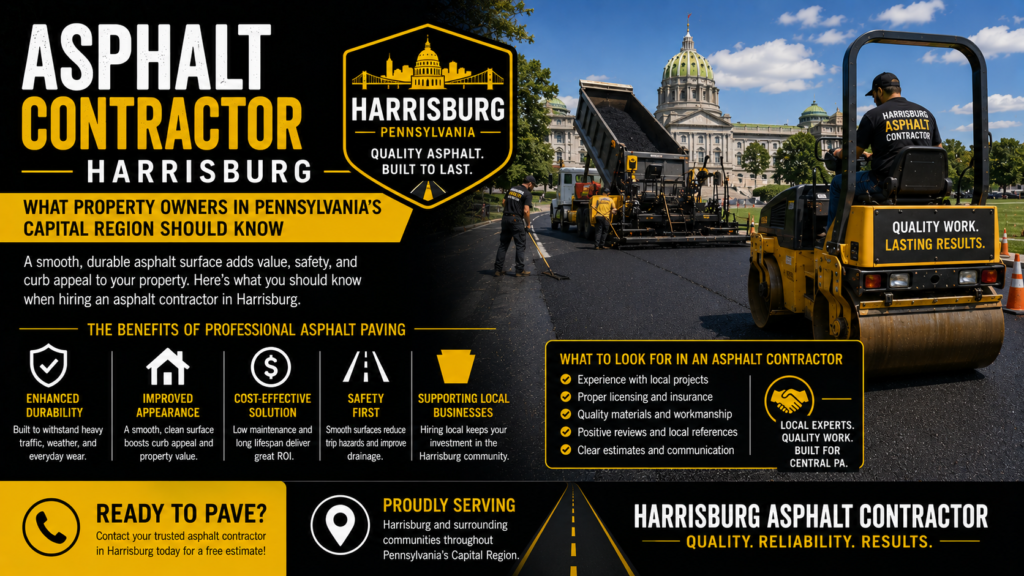
The Harrisburg asphalt contracting market includes both established regional companies and seasonal or transient operators. The characteristics that distinguish quality contractors from unreliable ones are consistent across the industry.
Licensing and insurance are baseline requirements. Pennsylvania asphalt contractors should carry adequate liability insurance and workers’ compensation coverage. These protections matter to property owners because they determine who bears financial responsibility if something goes wrong during or after the project.
Local experience in the Harrisburg region specifically is valuable because of the climate and soil conditions discussed above. Contractors who have worked extensively in central Pennsylvania have encountered the specific failure modes that Harrisburg’s environment produces and know how to engineer against them.
Transparent project documentation written proposals that clearly describe the scope of work, materials, base depth, drainage measures, and the project sequence separates professional contractors from those whose quotes provide minimal detail. The specifics of what a proposal includes or omits are often more informative than the bottom-line number.
References from comparable projects allow potential clients to verify that a contractor’s track record matches their claims. A contractor who has successfully completed driveways, parking lots, or roadways similar to the proposed project in the Harrisburg area is demonstrably capable of the work.
Harrisburg’s position as a growing, active city in one of Pennsylvania’s most dynamic regions means that quality pavement infrastructure is not a luxury it is a baseline expectation for properties that function well and hold their value. Understanding what quality asphalt work involves, and what distinguishes genuinely skilled contractors from the alternatives, puts property owners in the capital region in a position to make well-informed decisions about one of the more significant improvements they can make to their properties.